
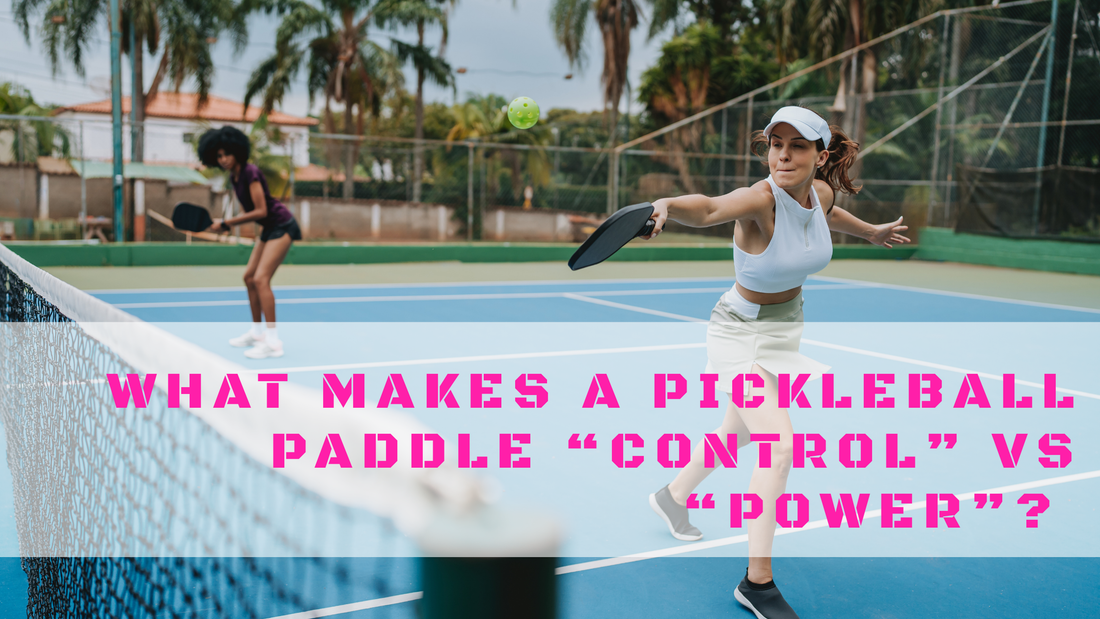
What Makes a Pickleball Paddle “Control” vs “Power”? A Simple Guide for SA Players
Introduction
Control and power are two of the most misunderstood terms in pickleball. This guide explains what “control” and “power” really mean in a paddle, how each affects your shots, and how South African players can find the right balance for their game.
What Do “Control” and “Power” Actually Mean?
A control paddle prioritises touch, accuracy, and consistency. It helps players manage dinks, resets, and placement with confidence.
A power paddle is designed to maximise energy return, producing faster ball speed with less swing effort.
Neither option is better overall. They simply support different playing styles. Both categories are represented across the pickleball paddles collection.
How Paddle Design Influences Control vs Power
Thicker cores absorb more impact energy, increasing control and forgiveness. Thinner cores rebound faster, producing more power. Carbon fibre faces enhance dwell time and touch, while fibreglass faces increase pop.
Paddle shape also matters. Elongated paddles favour reach and power, while wider faces provide stability and forgiveness. Together, these elements define how a paddle feels on court.
Which Paddle Style Suits Your Playing Level?
Beginners often benefit from control-oriented paddles that reduce errors and build consistency. Intermediate players usually seek balance, while advanced players select paddles based on tactical preference rather than skill limitation.
Understanding this progression helps players narrow options without relying on marketing labels alone.
South African Court Conditions Matter
Outdoor courts, wind, and harder playing surfaces are common across South Africa and often reward control-oriented paddles, particularly in doubles play. Power paddles can shine in singles or indoor environments where pace is easier to manage.
Common Myths About Control and Power
Power paddles aren’t only for advanced players, and control paddles aren’t weak. Placement frequently wins more points than speed, especially at club and league level.
Technology Behind the Labels
Manufacturers classify paddles based on measurable design factors such as core thickness, face material, surface texture, and shape — not subjective play-style labels. USA Pickleball outlines the technical specifications that govern paddle construction, materials, and performance limits in its official Equipment Standards Manual, reinforcing that “control” and “power” exist on a spectrum rather than as fixed categories:
https://equipment.usapickleball.org/docs/Equipment-Standards-Manual.pdf
This reinforces that control vs power exists on a spectrum rather than as a strict divide.
How to Choose Without Overthinking It
Ask whether you win points through placement or pace, whether you overhit or struggle with depth, and whether you play mostly doubles or singles. Your answers usually point naturally toward a control-leaning or power-leaning paddle.
Browsing the pickleball paddles collection allows you to compare these traits side by side.
Conclusion
Control and power aren’t opposing forces; they’re complementary elements of paddle design. By understanding how each affects your game, South African players can make informed decisions and choose paddles that genuinely support how they play.